Paying for College
Students who need financial assistance to help meet their college expenses should complete the Free Application for Federal Student Aid (FAFSA), available at https://studentaid.gov/h/apply-for-aid/fafsa as well as the New York State Tuition Assistance Program (TAP) and Excelsior Scholarship applications, available at www.hesc.ny.gov. For further information regarding the aid application process, please visit https://www.qc.cuny.edu/faid/.
The Cost of Education
The cost of education is an important consideration when deciding upon attending college. In general, a student budget consists of the direct educational costs of tuition, fees, books, and supplies, and those costs incurred by virtue of attendance, such as transportation and lunch. In addition, you will have recreational and personal expenses. If you are a self-supporting (independent) student, you will also have the day-to-day expenses of housing, food, clothing, and medical care.
Student Resources
In reviewing your budget, you should consider the resources you will have from earnings and savings, the amount your parents can contribute, and any benefits you receive such as Social Security, veterans’ benefits, unemployment, or public assistance. Summer employment can help you meet the first costs of enrollment, and you should plan to save money from such earnings. Cash will be needed right away for books, supplies, and transportation.
Packaging Financial Aid
Rather than using just one source to finance your education, a combination of monies from all the programs for which you are eligible may be used. This system for allocating aid is called “packaging.” Funds will be allocated first to meet the basic costs of attendance (tuition, fees) and, if funding permits, other expenses will then be addressed, such as books and transportation. Your need for aid is determined by an analysis of the information contained in your Free Application for Federal Student Aid (FAFSA).
The following sections briefly describe the financial aid programs available to eligible undergraduate students at Queens College. The descriptions are based on current statutes and regulations and are subject to change.
For additional information about application procedures and award and loan schedules, please visit our website at https://www.qc.cuny.edu/faid/ or contact the Office of Financial Aid Services.*
New York State Programs Tuition Assistance Program (TAP)
Application Procedures
Applications must be filed annually. Students must first fill out the FAFSA and then a separate TAP application. Students who do not file a FAFSA application can complete the Dream Act application through HESC website: www.hesc.ny.gov/dream/. If approved, they can then file a TAP application. The deadline for the 2026-2027 academic year is June 30, 2027. The New York State Higher Education Services Corporation (HESC) determines your eligibility based on the information provided on your application.
Selection of Recipients
TAP is an entitlement program for which there is no qualifying examination.
Requirements:
1. You must be a U.S. citizen, or eligible noncitizen, and be a legal New York State resident. Undocumented students can also apply for state aid through the Dream ACT. For more information on the Dream ACT, go to www.hesc.ny.gov/dream/.
2. You must be enrolled on a full-time or part-time basis and matriculated in a program approved for state student aid by the New York State Education Department.
3. All credits that constitute full-time basis is taking at least 12 credits or for part-time basis taking 3 - 11 credits for TAP for a given semester must be applicable to the degree for which a student is enrolled.
Note: Repeated courses for which a student has already received a passing grade may not count toward the full-time or part-time requirement unless required by the student’s curriculum.
* In compliance with the regulations of the City University of New York Board of Trustees, students who are delinquent and/or in default in any of their financial accounts with the college, the university, or an appropriate state or federal agency for which the university acts as either a distributing or certifying agent, and students who have not completed exit interviews as required by the Federal Perkins Loan Program, the Federal Family Education Loan Programs, and the William D. Ford Federal Direct Student Loan Program, will not be permitted to complete registration, or be issued a copy of their grades, a transcript of academic record, certificate, or degree, nor are they eligible to receive funds under the federal campus-based student assistance programs or the Federal Pell Grant Program unless the designated officer, in exceptional hardship cases and consistent with federal and state regulations, waives in writing the application of this regulation.
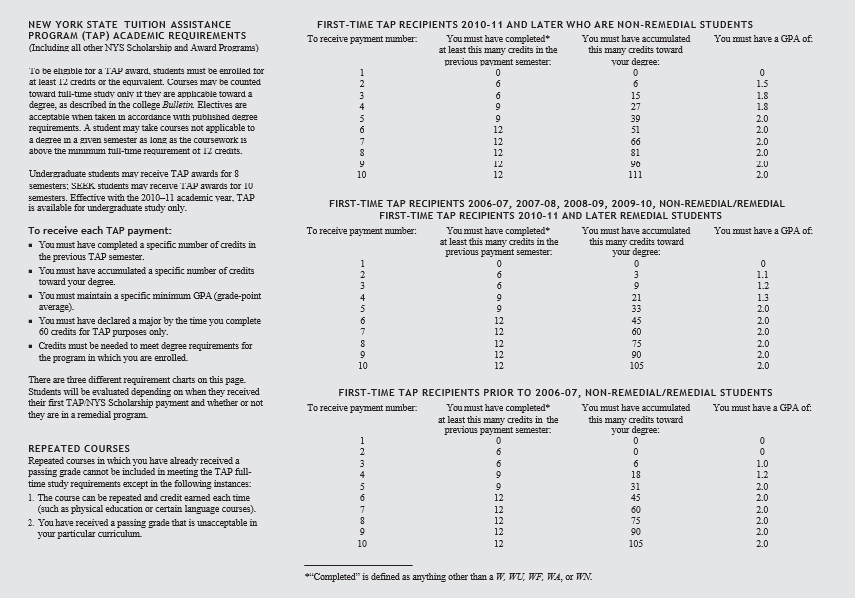
Additional requirements:
You must meet income eligibility limitations;
You must be charged a tuition of at least $200 a year;
You must not be in default in the payment of a student loan;
You must have declared a major no later than within 21 days from the end of the add/drop period in the first term of your junior year (60 credits or above);
You must have graduated from high school in the United States, earned a GED, or passed a federally approved “Ability to Benefit” test as defined by the Commissioner of the State Education Department;
You must have at least a cumulative C average after two annual payments;
You must be in good academic standing. See the Eligibility for TAP charts above for academic eligibility requirements.
Waivers
Waiver of Academic Standards
A one-time waiver of academic standards may be granted for extenuating or extraordinary circumstances beyond the student’s control, such as illness, etc., which cause the student to perform poorly academically.
Waiver of C Average Requirement
A waiver of the C average requirement may be granted for extenuating or extraordinary circumstances beyond the student’s control, such as illness, etc., which cause the student to perform poorly academically.
Students may request a waiver application from the College Counseling and Resource Center (Frese Hall reception area). You will be required to provide a written explanation of your situation and how it contributed to your academic performance as well as provide documentation. If granted a waiver, you will be allowed to receive TAP for the waived semester only. You will be required to meet academic standards for future payments.
Other New York State Programs
For information on the following scholarships and awards administered by HESC, see www.hesc.ny.gov.
Veterans Tuition Awards
Eligible students are those who are New York State residents discharged under honorable conditions from the U.S. armed forces and who are:
Vietnam veterans who served in Indochina between February 28, 1961 and May 7, 1975.
Persian Gulf veterans who served in the Persian Gulf on or after August 2, 1990.
Afghanistan veterans who served in Afghanistan during hostilities on or after September 11, 2001.
Veterans of the armed forces of the United States who served in hostilities that occurred after February 28, 1961 as evidenced by receipt of an Armed Forces Expeditionary Medal, Navy Expeditionary Medal, or Marine Corps Expeditionary Medal.
NYS Memorial Scholarship for Families of Deceased Firefighters, Volunteer
Firefighters, Police Officers, Peace Officers, and Emergency Medical Service Workers
NYS World Trade Center Memorial Scholarships
Flight 587 Memorial Scholarships Flight 3407 Memorial Scholarships
Military Service Recognition Scholarships NYS Excelsior Scholarship
NYS Math & Science Teaching Incentive Scholarships
NYS Scholarships for Academic Excellence NYS Volunteer Recruitment Service
Scholarships
NYS Regents Awards for Children of Deceased and Disabled Veterans
NYS Science, Technology, Engineering, and Mathematics (STEM) Incentive Program
NYS Achievement and Investment Merit Scholarship (NY-AIMS)
City University Supplemental Tuition Assistance (CUSTA)
To be eligible for CUSTA, you must be:
1. a legal resident of New York State for at least one year prior to entering college;
2. a high school graduate or recipient of a state approved equivalency diploma;
3. enrolled in an undergraduate program at a CUNY senior or technical college;
4. enrolled on a full-time basis;
5. eligible for the maximum TAP award;
6. at least a fifth-semester TAP recipient, not have exhausted your TAP eligibility, and have a TAP reduction.
The Percy E. Sutton SEEK Program
To be eligible, a student must be:
A resident of New York State;
Academically underprepared according to guidelines approved by the City University of New York;
Economically qualified according to guidelines approved by the Board of Regents and the Director of the Budget;
An applicant for admission as an entering freshman.
Federal Programs
Eligibility Requirements
To be eligible for the Federal Title IV student financial aid programs (FSEOG, Federal Pell, Federal Work-Study, Ford Federal Direct Loan, and FPLUS, you must:
Complete a Free Application for Federal Student Aid (FAFSA);
Be enrolled at least half time for all above programs except Pell;
Be a matriculated student;
Be a U.S. citizen or an eligible non-citizen;
Show evidence of need;
Not be in default of a federal student loan, or owe a repayment of a Federal Pell or FSEOG;
Make satisfactory academic progress in your course of study.
Title IV Academic Progress
In order for students to continue to receive federal financial aid (Title IV aid), they are required to complete their coursework in a timely fashion. To ensure that a student is making quantitative progress throughout the course of study, CUNY has established a minimum percentage of credits a student must successfully complete each academic year for the purpose of Title IV aid programs.
Students will be measured against these satisfactory academic progress standards at the end of the Spring term to determine eligibility for receipt of Title IV aid for the upcoming academic year.
Undergraduate Students
In order to be making satisfactory academic progress toward a degree, for purposes of receipt of Title IV Federal Student Assistance, an undergraduate student must achieve at least the GPA required for probationary status at the institution; after two years of enrollment at the college, at least a C average, or its equivalent, or academic standing consistent with the requirements for graduation; and accumulate credits toward the degree according to the following standards:
A. 150% Cap: Students may not attempt more than 150% of the credits normally required for completion of the degree. (All students must meet this minimum standard.)
B. Regular Standard: If a student has attempted fewer than 150% of the total program credits, his or her accumulated (or earned) credits must be equal to or greater than two-thirds the cumulative credits attempted at the institution.
A. Pace of Progression: For baccalaureate programs, accumulated (or earned) credits must be equal to or greater than a certain percentage of the total credits attempted, according to the following:
Attempted Credits | 15 | 30 | 45 | 60 | 75 | 90 | 105 | 120 | 135 | 150 | 165 | 180 |
Earned Credits | 0 | 5 | 16 | 27 | 42 | 50 | 63 | 72 | 84 | 95 | 110 | 120 |
All undergraduate students (whether or not they are aid recipients) will be measured against each of the three Satisfactory Academic Progress (SAP) components at the end of the Spring term to determine eligibility for receipt of Title IV student financial assistance in the upcoming year.
Appeal/Reinstatement
Undergraduate students who do not meet SAP standards may file an appeal by reaching out to the SAP Committee at Queens College.
These appeals will be evaluated for mitigating circumstances resulting from events such as personal illness, injury, personal tragedy, changes in academic program, and the reasonableness of the student’s capability for improvement to meet the appropriate standard for the degree program in which the student is enrolled. A successful appeal would result in the granting of a one-year probation period for the student to improve the academic record to meet the appropriate standard for the degree program in which the student is enrolled.
For more information regarding Satisfactory Academic Progress and Appeals, please visit our website: https://www.qc.cuny.edu/faid/sap-2/.
Note: Recipients of federal financial aid who withdraw completely from classes during any term may be required to return all or a portion of their federal aid received for that term.
Federal Pell Grant
The Federal Pell Grant program is an entitlement program. You must meet the eligibility requirements for federal programs listed above. Financial need is determined by a formula developed by the U.S. Department of Education and reviewed annually by Congress.
The Pell Grant is the foundation of federal student financial aid to which aid from other federal and nonfederal sources may be added. Federal grants are awarded to undergraduate students who haven’t earned a bachelor’s or graduate degree. Pell Grants are available at all CUNY colleges, but the college you plan to attend must be listed on your FAFSA. Almost all federal grants are awarded to students with financial need. The amount of your Federal Pell Grant depends on your cost of attendance, Student Aid Index (SAI), enrollment status, and whether you attend school for a full academic year or less.
Additional information:
Students will be limited to a maximum of 12 terms of full-time Pell payments or it's equivalent for part-time study.
Pell is only for students pursuing their first undergraduate degree.
You may not be in default on a previous federal student loan or owe the federal government a refund of previously received financial aid.
You must be willing to verify the information you provide on the FAFSA (If selected for verification).
You may not be convicted of possessing or selling illegal drugs while receiving financial aid.
Federal Supplemental Educational Opportunity Grants (FSEOG)
To be eligible, you must have exceptional needs and meet the federal eligibility requirements for federal programs listed above.
Federal Work-Study Program (FWS)
For students who are interested in applying for Federal Work-Study (FWS) for Fall 2026–Spring 2027 you must complete the current FAFSA at https://studentaid.gov/h/apply-for-aid/fafsa. File early; funds are limited. To be eligible, you must meet the federal eligibility requirements listed above.
The college may provide work-study employment to eligible students. In the even that more students are eligible for work-study than there are funds available. Students are welcomed to join the work-study waitlist by contacting qcworkstudy@qc.cuny.edu via email. Work-Study awarded students must be placed through the Office of Financial Aid Services and must follow placement instructions. Please know that job availability may vary depending on the time of placement.
For more information, please visit Financial Aid Services Work-study website at https://www.qc.cuny.edu/faid/federal-work-study.
Awards
The college arranges jobs on and off campus, with public or private nonprofit agencies (such as hospitals), for up to 20 hours per week during the academic year. The level of salary ranges from $18-$20 dollars according to job duties and work-site placement. Students must be meeting (SAP) satisfactory academic progress and must be enrolled in at least 6 credits at the time of placement. Enrollment must be retained throughout the semester to maintain eligibility.
Loans
Unlike grants or work-study, loans are a form of financial aid that you must pay back at interest rates that are typically lower than the consumer rates—usually not until after your studies have been completed or you fail to be enrolled at least half-time. The amount of the loan you seek and commit to should be determined only after all available grant-aid has been applied for. Federal loans are available to matriculated students only. Some loans may be forgiven if the student works in a particular program or government job after graduation. For more information, visit https://studentaid.gov/understand-aid/types/loans/subsidized-unsubsidized.
William D. Ford Direct Loan Program
Federal direct loan programs consist of low-interest loans and are available to both undergraduate and graduate students. Applicants for these loans are required to complete the Free Application for Federal Student Aid (FAFSA). Each loan also carries a small origination fee. Details about current year interest rates and fees are available on the federal student aid website at https://studentaid.gov/understand-aid/types/loans/interest-rates.
Federal Direct Subsidized Loans
Direct Subsidized Loans are available to undergraduate students with financial need. The U.S. Department of Education pays the interest on a Direct Subsidized Loan, while you are in school at least half-time; for the first six months after you leave school (referred to as a grace period), and during a period of determent (a postponement of loan payments). The interest rate on the Direct Loan can vary. For more information, visit https://studentaid.gov/understand-aid/types/loans/subsidized-unsubsidized.
Federal Direct Unsubsidized Loans
Direct Unsubsidized Loans are available to undergraduate, graduate, and professional students; there is no requirement to demonstrate financial need. You are responsible for paying the interest on a Direct Unsubsidized Loan during all periods. For more information, visit https://studentaid.gov/understand-aid/types/loans/subsidized-unsubsidized.
Federal Direct Plus Loan Program
A Parent PLUS Loan is a federal Direct Loan that a parent of a dependent undergraduate student can borrow to help pay for the student's educational expenses. To receive a parent PLUS Loan, you must be the biological or adoptive parent (or in some cases, the stepparent) of a dependent undergraduate student enrolled at least half-time at an eligible school, not have an adverse credit history (unless you meet certain additional requirements); and meet the general eligibility requirements for federal student aid. For each academic year beginning on or after July 1, 2026, the maximum amount of all Direct PLUS Loans that may be borrowed by all parents on behalf of each dependent student may not exceed $20,000. The maximum amount for all Direct PLUS Loans that may be borrowed by a parent for a dependent student over the course of their undergraduate study is $65,000 per child regardless of any amounts repaid, forgive, or discharged. For more information, visit https://studentaid.gov/understand-aid/types/loans/plus/parent.
If you are an undergraduate student, the maximum amount you can borrow annually in direct subsidized loans and direct unsubsidized loans ranges from $5,500 to $12,500 per year, depending on what year you are in school and your dependency status. Visit https://studentaid.gov/.
Aggregate Undergraduate Loan Limit. For dependent students, the limit is $31,000, and for independent students, it is $57,500. No more than $23,000 of either amount may be in subsidized loans.
Federal regulations require colleges to adjust ("prorate") Direct Loan amounts when a student is graduating and will not attend a full academic year. This most commonly affects students graduating during the summer ter or at the end of the fall semester, as they may qualify for a reduced annual loan amount based on their remaining coursework.
Beginning with the 2026-2027 award year, federal Direct Loan limits will also be adjusted based on enrollment intensity. Students enrolled less than full-time will be subject for a reduced annual loan amount, even if they are attending at least half-time.
Alternative Student Loans
These loans are typically sought by nonmatriculated students, international students, students attending less than half-time, and students who have reached their federal aggregate or annual loan limits. Alternative loans are credit-based, private education loans facilitated by a nonfederal, third-party lender. Students interested in alternative loans may borrow up to the full cost of their education minus all other aid. However, alternative loans generally carry a significantly higher interest rate because they are based upon individual credit score.
Veterans Administration (VA) Educational Benefits
Educational benefits are available through the Veterans Administration under the following programs:
New (post-9/11) G.I. Bill (Chapter 33) For veterans and service persons who served on active duty on or after September 11, 2001.
Montgomery GI Bill (Chapter 30)
Service persons who entered active duty between July 1, 1985, and June 30, 1988.
Vocational Rehabilitation (Chapter 31) Veterans who have at least a 10 percent disability as a result of active service.
Veterans Contributory Benefits (VEAP) (Chapter 32)
Veterans and service personnel who entered active duty after December 31, 1976, and who elected to make contributions from their military pay to participate in this education benefit program.
GI Bill (Chapter 34)
Veterans who served more than 181 days between January 31, 1955, and January 1, 1977.
Dependents’ Educational Assistance Benefits (Chapter 35)
Spouses and children of veterans whose death or total, permanent disability was service connected.
Montgomery GI Bill—Selected Reserve Benefits (Title 10, Chapter 1606)
For active-duty members of the Selected Reserve (components include the Army Reserve, Naval Reserve, Air Force Reserve, Marine Corps Reserve, Coast Guard Reserve, Army National Guard, and Air National Guard).
Reserve Educational Assistance Program (REAP) (Chapter 1607) For active members of the Selected Reserve called to active duty and members of the Individual Ready Reserve (Army IRR, Air Force IRR, Navy IRR, and Marine Corps IRR). These active members of the Selected Reserve must have served at least 90 consecutive days on active duty in response to a contingency operation declared by the president or Congress.
For more information regarding eligibility criteria for these programs and other assistance to veterans and their dependents, contact the Veterans Administration.
Federal Rules for the Treatment of Federal Student Aid Recipients Who Withdraw from School
If a student withdraws from all classes during a semester, the financial aid is calculated on a prorated basis according to federal regulations. The percentage of aid earned matches the portion of the semester completed. For example, completing 30% of the semester earns 30% of the scheduled aid. Students who complete at least 60.01% of the semester are considered to have earned all of their aid.
If more aid is disbursed than earned, the student or the College may need to return the unearned portion to the appropriate funding sources. If less aid is disbursed than earned, the student may be eligible to receive the remaining funds.
Students who withdraw may need to repay a portion of their financial aid to the federal government. Failure to do so may result in ineligibility for future aid until the balance is paid. If the College returns funds applied to tuition, the student will be billed for any outstanding balance.
Students who receive a WN grade (Never attended) from all courses are considered not to have attended for financial aid purposes unless they provide documentation of attendance. In these cases, all financial aid received may need to be repaid.
Students are strongly encouraged to consult a Financial Aid advisor before withdrawing from any courses.
Queens College Programs
Book Advance
Students will be eligible for a book advance if their financial aid exceeds their tuition and fees.